

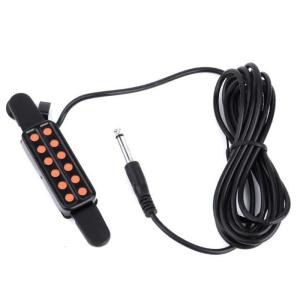
12 Hole Acoustic Guitar Pickup Sound Hole Pickup Magnetic Transducer with 6.35MM Plug Sound Cable Guitar Accessories

A professional guitar pickup eliminates external noise interference, produces clear tone and amplifies your guitar's sound. Padded clip design allows for easy installing or removing, needs no drilling, prevents damage to guitar panel. It enables to capture vibrations and directly convert them to an electrical signal, requires no driven. 12 Hole Acoustic Guitar Pickup Sound Hole Pickup Magnetic Transducer with 6.35MM Plug Sound Cable Guitar Accessories Features: A professional guitar pickup eliminates external noise interference, produces clear tone and amplifies your guitar's sound. Padded clip design allows for easy installing or removing, needs no drilling, prevents damage to guitar panel. It enables to capture vibrations and directly convert them to an electrical signal, requires no driven. Effectively reduce noise, the sound is evenly transmitted and stable. Comes with a cable, easy to install and disassemble at any time, convenient and practical. Specifications: Materials: copper,

Urban Living1
Urban Living1

Seller ratings 100%

Review

Oops
This video has no reviews.

You May Also Like

Ukulele Guitars For Kids Wood Color Plastic Musical Instrument Guitar Children Birthday Gift
00:14

Ukulele Guitars For Kids Wood Color Plastic Musical Instrument Guitar Children Birthday Gift

Procase 19 12U Skeletal Rack Mount Studio Mixer Stand Rolling Stage Cart tour case Dj
01:00

Procase 19 12U Skeletal Rack Mount Studio Mixer Stand Rolling Stage Cart tour case Dj

Ybeiyuan New LED Rotating Laser Beam Strobe 3-in-1 Disco Light DMX512 DJ Bar Club Party Wedding Christmas Effect Stage Light
01:09

Ybeiyuan New LED Rotating Laser Beam Strobe 3-in-1 Disco Light DMX512 DJ Bar Club Party Wedding Christmas Effect Stage Light

Bangtan Boys Ver.4 Kpop Special Edition Army Bomb Concert Lightstick for Fans
00:28

Bangtan Boys Ver.4 Kpop Special Edition Army Bomb Concert Lightstick for Fans

8/10 Inch Wooden Radiant Tambourine Handbell Hand Drum Double Row Metal Jingle Bells Percussion
00:20

8/10 Inch Wooden Radiant Tambourine Handbell Hand Drum Double Row Metal Jingle Bells Percussion

6Pcs .028-.045 Classical Strings Replacement Folk Guitar Nylon Strings 6-String Guitar Strings Perfect Intonation
00:12

6Pcs .028-.045 Classical Strings Replacement Folk Guitar Nylon Strings 6-String Guitar Strings Perfect Intonation

Adjustable Guitar Pedal Bench: A Comprehensive Guide
00:50

Adjustable Guitar Pedal Bench: A Comprehensive Guide

[BUY 1 TAKE 1]Disco RGB Par Light USB Powered Auto Rotate Night Light Christmas Party Decoration LED Stage Light Babalux
00:18

[BUY 1 TAKE 1]Disco RGB Par Light USB Powered Auto Rotate Night Light Christmas Party Decoration LED Stage Light Babalux

NIHONGO SO-MATOME N5: A Comprehensive Guide to Mastering Japanese Grammar, Vocabulary, Reading, Kanji & Listening
00:50

NIHONGO SO-MATOME N5: A Comprehensive Guide to Mastering Japanese Grammar, Vocabulary, Reading, Kanji & Listening

BRS Pharmacology 7th Edition: Your Ultimate Pharmacology Exam Preparation Guide
00:25

BRS Pharmacology 7th Edition: Your Ultimate Pharmacology Exam Preparation Guide

41inch Padded Acoustic Guitar Backpack Waterproof Gig Bag Electric Guitar Travel Case Adjustable Shoulder Strap Bag
00:18

41inch Padded Acoustic Guitar Backpack Waterproof Gig Bag Electric Guitar Travel Case Adjustable Shoulder Strap Bag

Magsulat sa Filipino: A Comprehensive Guide\\n\\n Introduction to Writing in Filipino\\n\\nLearning how to write in Filipino, also known as Tagalog, is essential for anyone interested in understanding and appreciating the rich culture and history of the Philippines. This comprehensive guide aims to provide a step-by-step approach to writing in Filipino, along with practical tips and resources to help you improve your skills.\\n\\n Understanding the Basics of Filipino Language\\n\\nThe Filipino language is a member of the Malayo-Polynesian language family, spoken by over 80 million people worldwide. It has been influenced by various languages, including Spanish, English, and other indigenous languages. As a result, Filipino has a unique blend of vocabulary, grammar, and syntax that makes it distinct from other languages.\\n\\n Importance of Learning to Write in Filipino\\n\\nWriting in Filipino allows you to communicate effectively with native speakers, understand Filipino literature and media, and appreciate the rich cultural heritage of the Philippines. By learning to write in Filipino, you can expand your horizons and connect with people from different backgrounds.\\n\\n Original Product Information & Specifications\\n\\nIn this section, we will provide an overview of the features of the Filipino language, as well as the key differences between Filipino and other languages.\\n\\n Features of the Filipino Language\\n\\nThe Filipino language has several unique features that set it apart from other languages:\\n\\n* **Vocabulary**: Filipino has a rich vocabulary that includes words borrowed from Spanish, English, and other languages. \\n* **Grammar**: Filipino grammar is relatively simple compared to other languages, with a subject-verb-object sentence structure. \\n* **Syntax**: Filipino syntax allows for flexibility in sentence construction, making it easy to express complex ideas.\\n\\n Key Differences Between Filipino and Other Languages\\n\\nFilipino has several key differences compared to other languages:\\n\\n* **Vocabulary**: Filipino has a unique blend of vocabulary borrowed from various languages, including Spanish, English, and indigenous languages. \\n* **Grammar**: Filipino grammar is relatively simple compared to other languages, with a subject-verb-object sentence structure. \\n* **Syntax**: Filipino syntax allows for flexibility in sentence construction, making it easy to express complex ideas.\\n\\n Description of Writing in Filipino\\n\\nIn this section, we will provide a step-by-step guide to writing in Filipino, along with common mistakes to avoid when writing in Filipino.\\n\\n Step-by-Step Guide to Writing in Filipino\\n\\nTo write effectively in Filipino, follow these steps:\\n\\n1. Learn the basics of Filipino grammar, vocabulary, and syntax.\\n2. Practice writing in Filipino regularly.\\n3. Read Filipino literature and media to improve your understanding of the language.\\n4. Seek feedback from native speakers or language experts.\\n\\n Common Mistakes to Avoid When Writing in Filipino\\n\\nWhen writing in Filipino, avoid these common mistakes:\\n\\n* **Incorrect spelling**: Double-check your spelling to ensure accuracy.\\n* **Poor grammar**: Review your grammar rules to avoid errors.\\n* **Lack of clarity**: Make sure your writing is clear and concise.\\n* **Cultural insensitivity**: Be mindful of cultural nuances and avoid offensive language.\\n\\n Practical Tips for Improving Your Filipino Writing Skills\\n\\nIn this section, we will provide practical tips and resources to help you improve your Filipino writing skills.\\n\\n Practice Makes Perfect: Exercises to Improve Your Writing\\n\\nTo improve your Filipino writing skills, practice regularly by:\\n\\n* Writing short stories, essays, or articles in Filipino.\\n* Keeping a journal in Filipino.\\n* Engaging in language exchange programs with native speakers.\\n\\n Resources for Learning More About Writing in Filipino\\n\\nTo learn more about writing in Filipino, explore these resources:\\n\\n* Filipino language learning apps, such as Duolingo or Memrise.\\n* Online Filipino language courses, such as those offered by the University of the Philippines.\\n* Filipino literature and media, such as books, movies, and TV shows.\\n\\n Conclusion\\n\\nIn conclusion, writing in Filipino is an essential skill that allows you to communicate effectively with native speakers, understand Filipino literature and media, and appreciate the rich cultural heritage of the Philippines. By following the steps outlined in this guide and practicing regularly, you can improve your Filipino writing skills and expand your horizons.\\n\\n Recap of Key Points\\n\\n* Learn the basics of Filipino grammar, vocabulary, and syntax.\\n* Practice writing in Filipino regularly.\\n* Read Filipino literature and media to improve your understanding of the language.\\n* Seek feedback from native speakers or language experts.\\n\\n Encouragement to Continue Learning and Practicing\\n\\nLearning to write in Filipino takes time and effort, but the rewards are well worth it. Keep practicing and exploring the language, and you will soon find yourself communicating effectively in Filipino.\n}
00:12

Magsulat sa Filipino: A Comprehensive Guide\\n\\n Introduction to Writing in Filipino\\n\\nLearning how to write in Filipino, also known as Tagalog, is essential for anyone interested in understanding and appreciating the rich culture and history of the Philippines. This comprehensive guide aims to provide a step-by-step approach to writing in Filipino, along with practical tips and resources to help you improve your skills.\\n\\n Understanding the Basics of Filipino Language\\n\\nThe Filipino language is a member of the Malayo-Polynesian language family, spoken by over 80 million people worldwide. It has been influenced by various languages, including Spanish, English, and other indigenous languages. As a result, Filipino has a unique blend of vocabulary, grammar, and syntax that makes it distinct from other languages.\\n\\n Importance of Learning to Write in Filipino\\n\\nWriting in Filipino allows you to communicate effectively with native speakers, understand Filipino literature and media, and appreciate the rich cultural heritage of the Philippines. By learning to write in Filipino, you can expand your horizons and connect with people from different backgrounds.\\n\\n Original Product Information & Specifications\\n\\nIn this section, we will provide an overview of the features of the Filipino language, as well as the key differences between Filipino and other languages.\\n\\n Features of the Filipino Language\\n\\nThe Filipino language has several unique features that set it apart from other languages:\\n\\n* **Vocabulary**: Filipino has a rich vocabulary that includes words borrowed from Spanish, English, and other languages. \\n* **Grammar**: Filipino grammar is relatively simple compared to other languages, with a subject-verb-object sentence structure. \\n* **Syntax**: Filipino syntax allows for flexibility in sentence construction, making it easy to express complex ideas.\\n\\n Key Differences Between Filipino and Other Languages\\n\\nFilipino has several key differences compared to other languages:\\n\\n* **Vocabulary**: Filipino has a unique blend of vocabulary borrowed from various languages, including Spanish, English, and indigenous languages. \\n* **Grammar**: Filipino grammar is relatively simple compared to other languages, with a subject-verb-object sentence structure. \\n* **Syntax**: Filipino syntax allows for flexibility in sentence construction, making it easy to express complex ideas.\\n\\n Description of Writing in Filipino\\n\\nIn this section, we will provide a step-by-step guide to writing in Filipino, along with common mistakes to avoid when writing in Filipino.\\n\\n Step-by-Step Guide to Writing in Filipino\\n\\nTo write effectively in Filipino, follow these steps:\\n\\n1. Learn the basics of Filipino grammar, vocabulary, and syntax.\\n2. Practice writing in Filipino regularly.\\n3. Read Filipino literature and media to improve your understanding of the language.\\n4. Seek feedback from native speakers or language experts.\\n\\n Common Mistakes to Avoid When Writing in Filipino\\n\\nWhen writing in Filipino, avoid these common mistakes:\\n\\n* **Incorrect spelling**: Double-check your spelling to ensure accuracy.\\n* **Poor grammar**: Review your grammar rules to avoid errors.\\n* **Lack of clarity**: Make sure your writing is clear and concise.\\n* **Cultural insensitivity**: Be mindful of cultural nuances and avoid offensive language.\\n\\n Practical Tips for Improving Your Filipino Writing Skills\\n\\nIn this section, we will provide practical tips and resources to help you improve your Filipino writing skills.\\n\\n Practice Makes Perfect: Exercises to Improve Your Writing\\n\\nTo improve your Filipino writing skills, practice regularly by:\\n\\n* Writing short stories, essays, or articles in Filipino.\\n* Keeping a journal in Filipino.\\n* Engaging in language exchange programs with native speakers.\\n\\n Resources for Learning More About Writing in Filipino\\n\\nTo learn more about writing in Filipino, explore these resources:\\n\\n* Filipino language learning apps, such as Duolingo or Memrise.\\n* Online Filipino language courses, such as those offered by the University of the Philippines.\\n* Filipino literature and media, such as books, movies, and TV shows.\\n\\n Conclusion\\n\\nIn conclusion, writing in Filipino is an essential skill that allows you to communicate effectively with native speakers, understand Filipino literature and media, and appreciate the rich cultural heritage of the Philippines. By following the steps outlined in this guide and practicing regularly, you can improve your Filipino writing skills and expand your horizons.\\n\\n Recap of Key Points\\n\\n* Learn the basics of Filipino grammar, vocabulary, and syntax.\\n* Practice writing in Filipino regularly.\\n* Read Filipino literature and media to improve your understanding of the language.\\n* Seek feedback from native speakers or language experts.\\n\\n Encouragement to Continue Learning and Practicing\\n\\nLearning to write in Filipino takes time and effort, but the rewards are well worth it. Keep practicing and exploring the language, and you will soon find yourself communicating effectively in Filipino.\n}